Showing posts with label Literature. Show all posts

Thursday, November 05, 2015

Where was your dharma then?

It is a common practice during the hunt that some men are used to create noise and push the prey towards a specific direction. The animal is taken towards a spot where it can be hunted be easily. The tamasha of returning awards, which the recipients got during earlier regimes, brings to memory the same practice. The self-styled authors and artists are crying hoarse in unison so that noise is created, government is forced to go in a particular direction and then it would be easier to hunt it down.

Those who are taking out their awards from the cupboards so that they could be returned claim that the freedom of expression is been curtailed in the country and the Fascist ideology is on the rise. Had they any iota of truth in their claim, one would have heed them seriously. However, the truth is otherwise. The questions are being raised on the hypocrisy of those who are shouting from their rooftops and these questions are being raised by none others than the one-time victims of their six-decade long hegemony.

“The same people who are raising voice for freedom of expression today controlled the fields of intellectual discussion and education. They had the monopoly. They made it their mission to trample any other thought than theirs. Where was their concern for the freedom of expression then,” asked noted Kannada writer S. L. Bhayrappa in Pune recently. Do the champions of free speech have any answer to this question?

Bhayrappa is not just another writer. He is among the pinnacles of the modern Kannada literature. His novels have established records in terms of popularity, sale and the appreciation of the critics, not only in Kannada but also in Indian literature. Every type of dirty trick was used to keep any government recognition or award from him.

Patil Puttappa is a noted Kannada writer and journalist. When Bhayrappa was sidelined and Dr. Chandrashekhar Kambar was awarded the Jnanpith Award four years ago, he openly said that a “big lobby was behind the selection of the awardee”.

Another noted writer Girish Karnad had come to Pune three years ago when he was asked a question about Bhayrappa. At that time, he had said, “Bhayrappa writes well, but he was swayed by Hindutva”. Thus, it doesn't matter what or how the author has wRritten, the only important point was that which ideology he followed.

This is why it assumes extra edge when Bhayrappa says that he was the victim of the suppression of free speech by the Leftists and they had no right to speak about of the freedom of expression. No more elaboration is needed about the inherent motives of the pre-planned outrage of the Leftists.

This was not the first sledgehammering on the one-sided love for freedom of expression of the Leftists. One such voice had come forward last month even before this bout of coordinated campaign of returning the awards started.

That was the voice of Prof. Sheshrao More. Prof. More is known for his extraordinary research on contemporary issues and mainly for his books on Veer Sawarkar which seek to change established conventions of the great freedom fighter and thinker. Besides them, he has written books on Kashmir, revolt of 1857 (which he says was a jihad and corroborates it with proofs) and the partition of India. Such is his exquisite detailing and solid writing, that a challenge was put at the time of third book that if anybody comes forward to refute claims in this book, another book on it would be published.

But alas, Prof. More refuses to portray Nehru as hero and Leftists as prophets of progressive thoughts, hence he was almost ostracized by the intellectuals in Maharashtra. However, last month, he was the President of the Vishwa Marathi Sahitya Sammelan held in Andaman and he fired first salvo on the hypocrisy of the seculars.

While attacking the self-styled progressives, he coined a term the Terrorism of Progressives which created a flutter in the progressive camp. Then either Prog. More was overlooked or he was termed a Hinduist. However, Prof. More was saying the same thing what Bhayrappa said recently and that many in the past said - the Leftists' love for freedom of expression was not absolute. It comes to fore only when their voice becomes feeble.

As for Maharashtra, there is another famous example in the form of late P. B. Bhave. Considered one of the four pioneers of the new age short story in Marathi, Bhave never received the acclaim he deserved mainly because he was a Hinduist writer, proud follower of Veer Sawarkar. What is more, when he was the president of the Marathi Sahitya Sammelan in 1977, the literary meet itself was thwarted. None of the artist or author fel free speech having been curtailed then. It was only since last year, when Narendra Modi became the Prime Minister, that they felt country was filled with the atmosphere of hatred.

This is very reminiscient of the Karna, who invoked the Dharma, when the wheel of his chariot got damaged. The question which Krishna and Arjun put before him then can be put today to the Leftists, Socialists and the self-styled intellectuals - Where was your dharma then?

Sunday, April 05, 2015

Marathi and Punjabi Warmth Gets New Manifestation

          Deputy Chief Minister of Punjab Sukhbir Singh Badal (right) presenting a sword to the Chief Minister of Maharashtra Devendra Fadnavis as Union Minister for Railways Suresh Prabhu (center) looks on.
The warmth of relations between Marathi and Punjabi received a new manifestation on Sunday as leaders from the two states thanked each other and announced a slew of measures for promoting each other’s culture in both states.
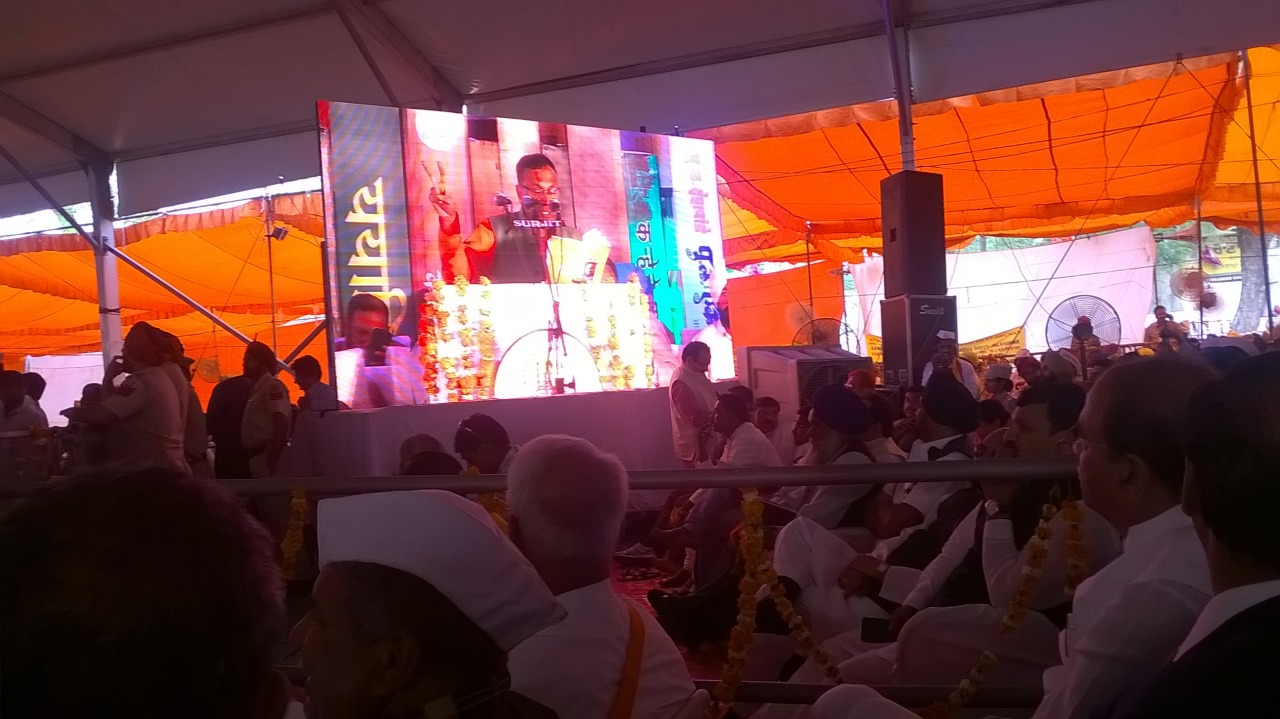
As the 88th All India Marathi Literary Meet concluded in Ghuman in Punjab, Union Railway Minister Suresh Prabhu, Chief Minister of Maharashtra Devendra Fadnavis, Deputy Chief Minister of Punjab Sukhbir Singh Badal and other leaders showered praise on both the cultures. Maharashtra’s Cultural Affairs Minister Vinod Tawade, Dnyanpeeth Awardee Kashmiri author Rehman Rahi, communist leader Jatinder Pannu were present on the occasion.
This is the first time that the Marathi meet was held in Punjab which the latter had declared as its official event. It provided all the infrastructure and hospitality facilities for the three day meet which was appreciated by all. Around 7000 people from Maharashtra camped in the small town of Ghuman, about 40 kms from Amritsar. The town is known for the memorial of Shiromani Bhagat Namdev, originally Sant Namdev from Maharashtra. Pune-based NGO Sarhad and Akhil Bharatiya Marathi Sahitya Mahamandal were the organizers of the meet.
Speaking on the occasion, Prabhu said, “While Marathi literary meet has truly crossed threshold this year, Punjab is the food bowl of India. Punjab and Maharashtra's relations are extraordinary. We can never think where martyrs Bhagat Singh, Sukhdev & Rajguru came from. Marathi people love bhagat Singh more than Rajguru. Marathi literary meet may help generate such gems for India. I am sure that literature can literary persons can bring people together.”
In his address, Badal said that it is Punjab’s tradition to respect all the religion on the world equally. He proposed that such an event should be held every year so that this exchange would go further. He reminded that Chief Minister Prakash Singh Badal had promised to set up a Chair in the Guru Nanak Devji University in Amritsar in the name of Baba Namdev. Badal also demanded that Ghuman should be brought on the railway map so that devotees from both the states can travel directly to the respective states.
Appreciating and reciprocating this gesture, Fadnavis said, “The literature lays the foundation for bridging linguistic and cultural barriers. I fully endorse Badal’s proposal and we will try to organize Punjabi festival in Maharashtra every year. Also, I announce that we will set up Shri Guru Gobind Singhji Chair in Swami Ramanand Teerth Marathwada University at Nanded. Digitization can do everything but it can't create sensibilities. Only literature can create sensibilities. Literature has infuse confidence in common man to fight adeversities and that larger community is behind him.”
All the leaders and dignitaries present in the ceremony, including Gen. (Retd.) J. J. Singh, Sikkim’s Governor Srinivas Patil, Pannu and Tawade thanked the Punjabi people and government for the excellent hospitality given by them.
Earlier in the day, the Union Minister of State for Environment and Climate Change Prakash Javadekar said that the Prime Minister Narendra Modi too have extended his warm greetings for this literary fest. Expressing gratitude of Punjab government in conducting this event, he said that he was thankful to the Chief Minister Punjab Prakash Singh Badal and the Punjab government on behalf of entire Maratha community for their hospitality.

Maharashtrians Enjoy the Punjabi Hospitality

The 88th edition of the Akhil Bhartiya Marathi Sahitya Sammelan (ABMSS) has given the Maharashtrians the occasion to enjoy the hospitality of the Punjabi people. The entire Ghuman village in Gurdaspur district has turned into Mini Maharashtra for the last threee days.

The literary meet,surprisingly, has become centre of attraction for many. The guests from Maharashtra are not only enjoying the Marathi programmes, but are also relishing the Punjabi programmes and most of all, the food. Every village in the town, apart from the Gurudwaras dotting the horizons, are filled with langars offering free food, tea, refreshments and even sugarcane juice.

Those visiting Punjab for the first time are having gala time and really enjoying the attention they are getting. Today, Vinod Tawade, Minister of Education and Culture of Maharashtra, visited the media center and said that even Maharashtra would not offer such hospitality as extended by the Punjab government. Many people I spoke to said that they would relish the moments spent in Punjab for the rest of their life.

Monday, March 02, 2015

Marathi Literary Meet in Punjab Creates Buzz

The 88th Marathi Sahitya Sammelan (literary meet) is to take place next month at Ghuman, Punjab. The choice of location has aroused quite an amount of curiosity. This is the first time that the annual meet is taking place in such a far away place. Everybody is anxious to know what happens to this mega event in a land where Marathi speaking population is scarcely available.

Organizing the literary meet out of Maharashtra is not a new development. This has happened earlier also and the Sammelans at Indore (Madhya Pradesh), Belgaum (Karnataka) or Vadodara (Gujarat) in the past have left their mark in cultural life of Marathi speaking populace. One meet was held even in New Delhi. Actually, the demand for United Maharashtra, a separate state for Marathi people, was made in such a meet at Belgaum. Still, the meet, which will take place in first week of April, has created a sort of buzz in Maharashtra.

Ghuman is situated in Punjab but its claim to fame is the samadhi- the memorial - of Sant Namdev, the 13th century saint poet who went to Punjab and spread the message of Bhagavat Dharma. Even though venerated by Punjab's population for almost nine centuries, it was almost forgotten place for Maharashtrians.

The initiative to hold this meet at Ghuman came from Sarhad, an NGO from Pune and its head Sanjay Nahar. When Maharashtra Sahitya Parishad, the organizing body for the meet, finalized this location as the next meet, everyone was puzzled. How will a meet, focused on Marathi language, be successful in a land where Marathi was not spoken for centuries and is not spoken even now.

However, the sarpanch and other functionaries from the village in Punjab visited Pune more than once and assured their full cooperation. Their gestures have shown a renewed cordiality which has made everyone yearn to go that land.

However, there is some roadblocks in the way. The Marathi publishers have decided to boycott the event saying that nobody would buy their books in Punjab where hardly anybody knows Marathi language. This threatens to be a major headache as large chunk of Sammelan’s revenue comes from the fees collected from the publishers to set up their stalls.

Nevertheless, Marathi literary meet has an extraordinary place in the cultural arena of Maharashtra.

Saturday, May 05, 2012

Professor of English Sues Publisher For Infringing Copyright

A former reader of Goa University, who is settled in the city, has filed lawsuits against two publishers and claimed Rs 25 lakh each in damages over copyright infringement after he allegedly found books written by him being sold without his permission at high prices.


Prof Anand Patil, former head of the English Department, Goa University, claims that he has not received the royalty amount for his books Western Influence on Marathi Drama published by Rajhauns Vitaran, 1993 and The Whirligig of Taste: Essays in Comparative Literature published by Creative Books, New Delhi.

He said that the academic books are also available online. Patil has also filed cases against Google Books and Amazon.com.

Patil, a resident of Dahanukar Colony, learnt about the piracy last month from his US-based daughter who told him that his books were available on Amazon.com.

“Western Influence on Marathi Drama was based on my thesis on which I had worked for 12 years. When I found that it was sold online for about Rs 4,000, I was shocked,” Patil said adding that after browsing further he found The Whirligig of Taste: Essays in Comparative Literature was also on sale.

“Both of these publishers did not pay a single penny. When I demanded an explanation, one of them denied having published the book. Rajhauns Vitaran has offered me a cheque of Rs 10,000 but my counsel advised me against encashing it,” he said.

“Since there is no authoritative work available in English on Maharashtra’s language, culture and traditions, my books are sought by researchers. My essay is included in Cambridge Sourcebook of Comparative Literary into Comparative Literature,” he added.

Patil said that he was not worried about recovering damages from Google Books or Amazon.com because they have a better Intellectual Property Rights policy and will settle the dues. “It is these two publishers that I want to teach a lesson,” he said.

Wednesday, October 21, 2009

Diwali issues in Marathi culture

As the Diwali approaches, so are the Diwali issue of Marathi magazines. Diwali issues are the hallmark of the festival for the Marathi people and Maharashtra. Many houses in the state get a hint of the festival's arrival by thick issues of magazines stacked on the news stands. Its cultural standing is matched only by the Durga Puja issues brought out by Bengali newspapers and magazines. Many writers in Marathi owe their career to the existence of the Diwali issues only. In north India, Diwali means gifts and present full of mithai boxes. In Maharashtra, mithai is accompanied by Diwali issues.


It was exactly hundred years ago, that the first Diwali issue of Manoranjan, a popular magazine of that time saw light of the day. Since then, the tradition has only grown to encompass in it all types of print as well as new medium publication. Some years ago, there came audio Diwali issues, then with advent of time they changed into video ones. Now, more than five web portals in Marathi bring their own issues. In one such issue last year, I wrote about the advent of web technology in indigenous languages. Diwali issue is a thing of status in Marathi media and no publication is complete unless it has one. Actually this will be a statement as there are more brands of Diwali issues in Marathi than the reqgular magazines. Some like Awaz, Ravivarchi Jatra, Maharashtra Times and Loksatta have a tradition of almost five decades and they require no marketing. Some like Dhanurdhari come only in Diwali issue form but are always looked forward to.

Even though known for their entertainment value, the Diwali issues have contributed to the exchange and growth of thought in Maharashtra. Prior to arrival of TV and web media, it offered a platform for discussion or debate an many controversial topics. Much of today's contemporary Marathi literature owe its existence to the Diwali issues. Not limiting to that, they have also helped put new thoughts. It is not surprising to find Diwali issue dedicated to women's issues or philosophy, medical issues or astrology lined up for sale. It is also not a novelty for the Marathi readers to find these issues selling like hot cakes. Even though one can find older people grudging about the decreasing habit of reading, the sale of the Diwali issue do not stand witness to that. The business of publishing Diwali issues have stood test of time. Even advertisers do not shy away from putting their money in it.

Friday, March 20, 2009

No President for Marathi Meet

Freedom of Expression Takes Backseat
The Marathi Sahitya Sammelan (Marathi Literary Meet) will take place in Mahabaleshwar without any presiding authority. Yes, the meet which is to start from Friday will have no president. This is the first time in the history of the meet that it will be conducted without president.

The meet is scheduled to start in Mahabaleshwar from March 20. Anand Yadav, the path breaking author who started era of rural literature in Marathi was elected as the president of the meet through an election process conducted all over the state. He has written a novel 'Santsurya Tukaram' which has invited wrath from the Warkaris in the state. According to Warkaris, the novel depicts Tukaram in bad light and has defamed the revered saint. After the controversy erupted about a month ago, Yadav had first refused to budge saying that Warkaris do not know what a novel is. Then he relented and withdrew his novel from the market.

Not pleased with this, Maharashtra Warkari Mahamandal, a body of warkaris demanded an apology from Yadav. Two days ago, Yadav submitted his written apology at Dehu, the place of Tukaram. He was reportedly manhandled and abused by warkaris there. Finally, Yadav tendered his resignation on Tuesday. Warkaris had threatened that in case Yadav dose not resign, 10,000 warkaris will start agiatiation in Mahabaleshwar.

"I have nothing to say on this affair. I just gave up the fight so that this annual literary meet is not hampered by some forces,"
Yadav said two days ago. One day after tendering his resignation as the president elect of 82nd Annual Marathi Literary Meet (Akhil Bharatiya Marathi Sahitya Sammelan). Yadav is in no mood to speak about the extra-constituential censorship.
He said, "What should I do when there are forces bent to disrupt the meet for the sake of a person? In earlier times, people (media) used to come forward in defence of freedom of expression. But this time everybody is silent. I am sorry but I have chosen to be silent."
A meeting of Akhil Bharatiya Marathi Sahitya Mahamandal was conducted yesterday in Mahabaleshwar. It was decided in the meeting that the meet will take place in the absence of a president.

Who is Yadav
Anand Yadav, 82 years old, was born in a small village Kagal near Kolhapur. He completed Ph.D. at Pune University. His writing began a new era in Marathi literature called Gramin Sahitya i.e. rural literature.

Yadav's novel Zombi (lit. 'Fight against all odds') won the Sahitya Akademi Award in 1990. Zombi is a realistic novel that narrates the story of small 'Andya', his eagerness to learn, his life in sheer poverty, his loving mother and illiterate rural father.

His second novel, "Nangarni" (cultivation of the soil), is a sequel to "Zombi". It narrates his struggle during youth and the challenges he faced in settling down in life. The third autobiographical novel of this series, "Gharbhinti", describes his adult life--his marriage, daughters' education and support of family back in Kolhapur.