Showing posts with label Water. Show all posts

Saturday, July 15, 2017

Monsoon covers entire Maha, brings relief to farmers

The south west monsoon has covered all parts of Maharashtra bringing good rains and relief to farmers. The Pune city, along with many other parts of the state, witnessed moderate rains today.

The central part of Maharashtra is a major food grains growing area and rainfall in this region has brought relief to farmers as well as the state administration.

"For the first time in July, the south west monsoon has brought rains to all parts of the state. There had been showers since July 1, but of low intensity and scattered. It is good that the entire Maharashtra is now covered," an official of the India rpt India Meteorological Department told PTI.

"The central parts of the state - comprising north Maharashtra and Marathwada - received showers of medium intensity. It will be helpful for farmers as the state was facing a potential challenge of second round of sowing in the region," he said.

"The second round of sowing means an additional input cost to the already debt-ridden farmers," the official said.

Maharashtra agriculture minister Pandurang Fundkar told PTI that sowing on over 66 per cent of the total area has been done during the ongoing Kharif season.

The state administration was a bit worried over the delay in rainfall. Chief Minister Devendra Fadnavis had even issued an advisory for postponing the sowing, he said.

"As of today, the sowing has taken place on more than 66 per cent of agricultural area in the state. We are a bit relieved now," Fundkar said.

A report from Nashik said incessant rains lashed the city and other parts of the district after a dry spell, leading to water logging in low-lying areas.

The water level of Godavari river has risen following heavy downpour since last night in the catchment areas, an official said.

The irrigation department has not released water from the Nashik's Gangapur dam owing to the heavy rains.

Saturday, June 30, 2012

Least Rains In This June

It is official now. As the June comes to end, it recorded lowest rainfall in this month during the last decade. The city has recorded only 34.5 mm of rainfall since June 1 which is only one third of the average rainfall for the month.

As per the India Meteorological Department, The average rainfall for the city in June is 116.1 mm. However, the rainfall recorded at Pune station of IMD since the start of this month was only 34.5 mm, at Lohegaon it was 25.1 mm while at Pashan station it was 34.4 mm. This trend is in line with other districts in the state where only 7 out of 35 districts have registered the average rainfall for this month.

The lowest rainfall in June for city during last decade was three years ago, when 117.5 mm rainfall was recorded. But the situation in 2009 was helped by 55.5 mm rains during the 24-hour period on June 6. This time around, the maximum rainfall did not go beyond 3 mm.

Meanwhile, scant rains in the catchment areas of the dams have helped the water scarcity situation a little. The Temghar dam has recorded 2 mm of rains and Warasgaon and Panshet dams have recorded 3 mm of rains overnight. This has meant an insignificant increase in the level of water in all these dams.

Tuesday, August 18, 2009

Water cuts in cities across Maharashtra

With the situation of rain worsening in the state of Maharashtra, cities across the state are bracing for the cut in water supply. Following the example of Pune, now Aurangabad is also set to face a 30 percent reduction in the daily water supply. As the rain god has chosen to remain away, the dams have failed to fill. This has forced the administration to enforce stricter measures.

Pune and Pimpri-Chinchwad Municipal Corporations announced on Monday to impose 30 and 20 per cent water cutsrespectively. State Water Resources Minister and guardian minister of city Ajit Pawar had ordered the cut in view of the water scarcity. "Last year by August 15, four dams that supply drinking water to Pune were filled up completely. As there is no sufficient rainfall this year, water storage is only 70 per cent of dams' capacity," Pawar informed after holding meeting with officials here today.
In Pimpri-Chinchwad where the dams suppling water to city were filled only up to 80 per cent, Pawar said.
A day after that, municipal corporation of Aurangabad also decided to reduce the water supply by 10 percent. The announcement was made by the guardian minister of the district Radhakrishna Vikhe Patil. Jaikwadi Dam, which is responsible for the water supply of the district has just 15 percent of water storage now. Minister also warned that the situation does not improve, meaning that if there are no rains in the return of monsoon, then the water cut can go higher. The situation is so severe that even supply to National Thermal Power Plant at Parli is also on the brink of severance. Local bodies in Gangapur, Vaijapur, Sillod, Khulatabad, Paithan and Kannad are also told to lessen their water use.

For the last ten days, I was in Nanded, the city of present chief minister of Maharashtra, Ashok Chavan. Ahead of the state legislative assembly elections, Chavan is on a promising spree in his home town. But he can not the assure the residents of Nanded a better water supply. It was in the month of June that extra money was pumped in the Godavari river flowing through Nanded so that the need of drinking water be fulfilled. There are no rains in the reason and state government has already declared 140 villages as drought affected. The residents are getting only one time water supply.

According to Ajit Pawar, all the reservoirs in Maharashtra together hold 15,252 million cubic meters (MCM) of water as on Monday, which is down from 19,206 MCM in the corresponding period previous year. The total installed reservoir capacity for the state is 33,085 MCM. Water availability remains only 12 percent of the installed capacity in the Marathwada region. Koyna dam has only 83 per cent water stored, while Jayakwadi and Ujani have 13 per cent and 33 per cent respectively.

Thursday, July 16, 2009

Problems Galore Even After Rains

The Pune city is getting satisfactory rains for the last three days. The dams supplying water to the city are filled sufficiently. Still the troubles are not yet over for the city as the rain is not so heavy today as previous two days. The water supply to the city was reduced by 40 percent in the first week of this month due to absence of the rains.

The water situation in Pune district is satisfactory now as all the dams are filled more than 50 percent. According to the Irrigation Department officials, which controls the water distribution in the state, Pune needs four more days of heavy rains to bring the water supply to normal. As on today, the liver storage in the dams is as follows: Khadakwasla 85.53%, Panshet 23.93, Warasgaon 15.62, Temghar 25.71, Mulshi 38.58 and Pawana 43.62.

The good rains on Tuesday took the level up in dams across Pune region. The situation was so bad that Warasgaon and Temghar dams had zero percent water storage before the rains. The rains started Monday night. The rainfall experienced in the catchment areas of these dams was sufficient to fill the gap and these two dams started having live storage.
Still, the roads were seen clogged on Wednesday and Pune residents are still getting the water in less proportion. Last year, there was exactly similar situation here but neither people nor administration learned any lesson from the situation. Ajit Pawar, guardian minister of Pune and also the Water Resourced minister of Maharashtra will take a review meeting hopefully within a week. That will decide the fate of water supply in the city. For now at least, the problems persist in the cultural capital of Maharashtra.

Thursday, July 02, 2009

More Water Cuts For Pune

Administration Cautious Over Scarcity

Some water in the form of drizzle came in Pune city today even as the city reeled under water scarcity. The dams providing water to citizens are running dry. Guardian minister of Pune and state water resources minister Ajit Pawar today announced some measures to check the water scarcity, but in absence of sufficient rains, it is way far from satisfactory.

Pawar held a meeting today in which officials from various departments were participated. Besides divisional commissioner Dilip Bund, Pune Municipal Commissioner Mahesh Zagade and mayor Rajlaxmi Bhosale with mayor of Pimpri Chinchwad Aparna Doke were present in the meeting. The reduction in water supply was increased from 30 percent to 40 percent in the meeting. Along with it, every ward in the city will have five bore wells now as well as each ward will be supplied water with tanker. Water in the Veer, Bhatghar, Khadakwasla, Varasgaon, Panshet, Pavana and Temghar will be reserved only for the drinking purposes.


Pune experienced some rains today which expects to revives sales of these hawkers who had a very bad season this year.
Pawar said that even after about a month since the onset of monsoon, the rainfall in the vicinity of city is not sufficient. Water supply to the city is done through six dams and on average, the storage in these dams is way below 10 percent.

PMC gets around 11.5 TMC (Thousand Million Cubic Metre) water from the four dams per ay. Now, the stock of water is 0.54 TMC which might get over in about 15 days.

Wednesday, June 24, 2009

Rain God Still Away

We Need the Rains Badly

Finally, Indian Meteorological Department has modifies its prediction regarding the rainfall in the country. The department has now said that the rainfall will be below normal for the month of July. Minister of state for Science and technology Prithviraj Chavan today announced this in the capital New Delhi. In the first prediction given by the department, the rainfall in July was expected to be 96 percent.

Agriculture Secretaries of states, including Maharashtra that have not received rainfall yet are slated to meet union Agriculture Secretary on Wednesday in this regard.

The march of the Southwest monsoon, crucial for the agricultural purposes and also for the drinking water in urban areas, has been standstill since June 7.

In Pune, the south-west monsoon normally arrives in the first week of June. Even though the city has witnessed thunderstorms and rains in between week, the actual season is far from here. The city has recorded 117.2 mm of rains since June 1. Ironically, the average rainfall for the city is 116.1 mm. Hence, actually the average has been crossed.

IMD’s status report uploaded last week informed that southwest monsoon set out over the Andaman Sea around its normal date on May 20. It set in over Kerala on May 23, about a week earlier than normal. Meanwhile, a cyclonic storm Aila formed in the Bay of Bengal resulting in the advance of the monsoon over north-eastern states, West Bengal and Sikkim. After a hiatus of about a week, the monsoon further advanced along the west coast and reached Ratnagiri on June 7.

This has obviously put pressure on the dams providing drinking water to Pune. The municipal corporation has already effected 15 to 20 percent of water cut till July.
There are six major dams that provide drinking water to Pune. and Pimpri-Chinchwad namely Temghar, Varasgaon, Panshet, Khadakwasla, Pavana and Mulshi. The water levels in these dams has touched a low.

Saturday, June 20, 2009

New Spells of Rain

But Where is Monsoon

Pune witnessed new spell of rains in the season on Saturday. It comes on the background of a 20 percent cut in the water supply of the city. Still, this rain is not sufficient for fulfilling the needs of the city. Officials say that at least 10 days of rainfall will be needed for the water supply to resume at original level. Meanwhile, the meteorological department clarified that the rains on Saturday were not that of monsoon but conditions are favourable for the advance of monsoon.

City recorded a rainfall of 39.7 mm till till 5:30 PM on Saturday. Sources in meteorological department told Pune Mirror that these were pre- monsoon showers. But conditions are very favourable for the advance of monsoon in most parts of the state including Mumbai. The monsoon is expected to arrive within 48 hours.

I was to Junnar yesterday and while returning, there was quite a good spell of rains. But here in Pune, the rain gods seems to have lost interest in visiting the city. It is a repeat of last year albeit a bit different. Last year, the monsoon had arrived on time but the rains came very late at the end of June. Normal onset of monsoon for Pune is June 7 but this time it is testing too much. I hope it comes soon!

Sunday, May 10, 2009

Wealth From the Waste

Vehicles prohibited from dumping garbage

Only Remedy to Assuage the Problem of Garbage


Can the city dump its unserviceable lifestyle on the areas adjoining it. This question has been brought to forth by the strong agitation carried out by the residents of Uruli Devachi near Hadapsar. The villager of this small village are protesting against the garbage depot for last many years. The latest agitation is going on for four day in a row and today is the fifth day. But the issue has been overlooked by all and sundry. There have been even instances in the past where the water in the wells of the village has been proved to be contaminated with poisonous matters because of existence of garbage depot.


The garbage depot was first situated in Kothrud. But owing to the rising complaints from residents nearby, the Pune Municipal Corporation decided it to be shifted to Uruli Devachi. What was a problem essentially of city dwellers was sent to the villagers ho had nopart to play in it. After about a decade, the vicious effects of 1000 to 1200 tonnes of garbage being dumped daily are felt. Besides the pollution, it has also posed health hazards. Just three months ago, a fire started in the depot which lasted for more than a week. Demands were made in past with Maharashtra Pollution Control Board (MPCB) authorities to rein in PMC.But MPCB has done little except issuing notices to PMC for “unscientifically” dumping the garbage.


Now that the garbage dumping has been stopped in Uruli Devachi, the heaps of garbage are piling up in the city. Complaints about the same have also been sounded. But one must look at the problem not through one side. City dwellers pride themselves and are always demanding for the new conveniences. But once their needs are fulfilled, these conveniences make a huge amount of garbage. And new trash dumps are always needed to put this waste. That's where the areas like Uruli Devachi come in. This area has been used as a dumping ground since 1983.

While Pune has developed multitudinously during last two decades, the adjoining parts of the city are best sites to develop housing and waste disposal as well. Fursungi, Vishrantwadi and such areas are looked upon as the best supporting land for the growing needs of citizens. You have industrial waste? dump it at Fursungi. You have drainage and human waste? Dump it in the rivers. This is the standard approach of civilized and democratic Puneites coming from all over the world. Nobody bothered to aks the villagers whether they want to accommodate the remains of human bodies, ash and decomposed food items, old and defunct parts of the machines that were engaged in building successful businesses, the dust and everything else that was thought not to be fit enough to keep in the city.

So this is the reason why the villagers are up in arms over the garbage issue. It is not about the rural versus urban divide. It is about arrogance versus existence. City's arrogance has reached its threshold and existence of the areas near cities is in question. The remedy? I am tool little and uninformed to suggest a remedy over this much big a problem. But it will be always good if we can find a way to create wealth from waste!

Wednesday, April 29, 2009


The supreme court has finally hit the nail. Everyone concerned with the grave situation in the country must welcome the honorable court's ire towards non performance of the successive governments towards the water crisis.

The Supreme Court on Tuesday linked the existence of government to the solution of water shortage in the country. According to the court, government has no right to be in power if it does not solve the problem. It is largely on the one of the famous lines byu Sharad Joshi, veteran farmer's leader : Sarkar kya samasya suljhaye, jab sarkar khud ek samasya hai! (How can government solve a problem, government itself is a problem)
"Government has no right to be in office. You have no right to be in office if you can't provide water," Justice Markandeya Katju heading a bench with Justice H L Dattu told Additional Solicitor General Parag Tripathi appearing for the Center.
The court also constituted a committee to be headed by the Secretary, Union Ministry of Science and Technology as its chairman, and Secretary, Union Ministry of Water Resources as a member, apart from scientists. It said the committee should be entrusted the task of conducting a scientific research on a war footing to find inexpensive methods of converting saline water from the sea into fresh water.
Closer home, city of Pune has its woes of drinking water. Pune Municipal Corporation has gone on record to say that the existing system of water supply is not fully capable to provide water judiciously. Currently, there are 50 tankers providing water to the citizens in city. This arrangement is mainly for those citizens living in suburban areas.
Last year, when the rain god played hide and seek in the early months of monsoon season, there was large hue and cry by corporators belonging to all parties. According to Irrigation Department, the norms for the water supply in urban area stipulate that each person should get 150 Litres. of water every day. The Pune Municipal Corporation (PMC) area gets 11 thousand million cubic meters (TMC) water everyday. This translates into 400 cubic seconds (Cusecs) of water flow. Of this, 40 per cent is relayed to the city from pipelines and 60 per cent through canals. Since the water runs thorough this pipe line for 24 hours, the areas located near this line enjoy water supply all the time. That affects the parts located far away from the water purification centre. However, the good news is that the water level in the dams providing water to the city is four per cent more as compared to last year.
Water shortage in Pune division touched a high in 2003 when following three successive years without rains, as many as 905 tankers were deployed for the water supply. This time around the situation is not so grave, but in nearby Satara district things are in bad shape. The district administration has employed 13 tankers as well as bullock carts to supply water to the people.
On the state level, Groundwater Surveys and Development Agency (GSDA) has completed the Groundwater Resource Estimation of Maharashtra in 2004 on watershed and taluka basis. According to GSDA estimation, out of total 1505 watersheds, 76 are categorized as overexploited meaning that groundwater development is more than 100 percent of the recharge there. 20 are categorized as critical and 163 watersheds are categorized as Semi-critical. 

Tuesday, March 17, 2009

Good Morning Spelt Death for Him

Can a Good Morning kill you? Literally. A villager in Supe learned this hard way before he bid goodye to the world.
According to a PTI story, Sunil Jadhav, 42 years, lost his life due to the members of Good Morning squad chasing him. The incident led to tension in the village.
Jadhav owned a barber shop. He took fright when "Good Morning" squad comprising Panchayat officials, gave him a chase as he ran towards home. He suffered cardiac arrest and collapsed on the way, police said, adding Jadhav could have been a heart patient.

The tragic incident enraged villagers and relatives of the deceased refused to take charge of the body. Finally, tehsildar of the area gave a written assurance of financial help to the bereaved family settling the matter. Local residents said they were not able to use toilets built due to paucity of water being experienced in the summer.
Good Morning squad consists of district administration officers. It is formed to drive away the villagers from defecating in the open and use toilets instead. The squad members chase the people who defecate in the open or charge a fine who are caught 'red hand.'

Saturday, January 31, 2009

Trip to Purandar

The Departure

से My Photographs
Even before the day begun on January 26th,  we had decided to go to Purandar fort this time. There was a lot of deliberation over the matter between us friends for over two months. But it would have been foolish to let go this opportunity given by Republic Day to refresh ourselves. Our first choice was Rajgad, but as one by one members of our team walked out, only me and Tanaji found ourselves on the road. It was about eight o’clock in the morning when Tanaji drove away from Swargate, me riding behind him. He took me all the way to the fort and bought back safe and sound. When we were back, I felt each part of my body was rebelling like the people in socialist parties do. I could just wonder what the condition of Tanaji was.

The Road to Hell

से Purandar
While  embarking on the trip, we had no fair idea as to what is the condition of the road to this historic fort is. I had read many times kind of travelogues trekkers and tourists have written about the fort. In July last year, I almost made it to the fort but came away midway sincew I thought I would not get enough time. I was correct in that respect as the fort stretches to a bvast land and it has a hright of almost 22,000 ft above sea level.

However, it is the road to the fort that tests one’s patience and endurance. It seems as if the road was made in tar first at the time of Shivaji and since then there has been no repairs. The pebbleshave all beenspread on the road as if one spreads butter on a slice of bread. The vehicle have to be extra conscious for being skid or developing punctures. It also consumes a lot of energy also. If the second most important fort in Shivaji’s kingdom can be neglected like this, how far can one expect about other historical places. The slope leading to Purandar fort is one of the messiest roads in the world, to say the least. If anybody asks me an advice, I would rather say that take your vehicle to the base of the fort and thereon keep climbing by foot. It will consume your time and energy, but it won’t bring you a sense of helplessness, loneliness and frustration which the vehicle road will bring. And if it is dangerous and tiresome while climbing, it is 100 times more dangerous and time consuming while coming down.


The First View

से Purandar
The path to fort might be beset with difficulties, but once you set your foot at the entrance of the fort, it is only history and valor that surrounds you. At the entrance of the fort, a statue of Murar Baji Deshpande has been erected in honour to this great fighter. Murar Baji was the custodian of the fort when Moghul commander Dilerkhan attacked the fort in 1665 Dilerkhan bombarded Purandar with artillery but could not win over the fort. With his handful of men, Murar Baji was fighting the enemy. It is said that Khan had offered him to come to Mughals and be rewarded but he chose otherwise. This brave warrior gave up his life in defending the fort for his beloved king, Chhatrapati Shivaji. The statue sufficiently shows the bravery and valor of the fighter. It also reminds one that Maratha empire was created from the contribution of such selfless people.

The statue is at a relatively flat area and there is a lake nearby. In historic times, this might have been used by the people living on the fort for drinking water but is not used now. As one passes by the statue, the grand remnants of the fort can be seen in the background.


The Grand Neglect

If you think you can skip Purandar for want of excitig attractions, you may be forgiven. It does not have the proximity or ease like Sinhgad and it does not have charm or monuments like Shivneri or Pratapgad. Whatever remnants one sees on Purandar are standing in utter neglect. To make it worse, no information about these mute witnesses to history is available on the fort. There are buildings on the fort suggesting that British officers enjoyed a good stay here prior to 1857 but that is also not explicitly displayed. We can draw only inferences or make guesses based on the structures. There are two identical buildings here which might have been churches as the place for bell can be clearly seen. The walls of these churches have been littered with names of those who unfortunately happened to have visited the sites. Unable to produce such grand examples themselves, they have instead chose to put their names on the existing building.

से Purandar
There are also barracks on the fort supposed to be used by the soldiers of East India Company. All these are abandoned now except for those which are given to National Cadet Corps. NCC controls some part of the fort even now.

After returning to Pune, when we searched the history of the fort, it was found that the German war criminals were placed on the fort after the two world wars. The construction of the buildings and manner in which they are standing reinforces the fact. The authorities, that of Archaeological Survey of India (which controls the fort) and revenue department of Maharashtra (under which the territory comes) either think that every tourist is well informed about this history or they just do not want everybody to know the same. Otherwise they would have placed some boards, guides or something to that effect. The forgotten grandeur of this historic witness is matched with the equally grand neglect by present authorities.


The Vast Expanse

से Purandar
Looked from the Narayanpur, from where only you can go to fort, Purandar seems very small. Its magnificence is not so imposing as the Sinhgad. But once you are at the top, one realizes what an expanse this fort has. Along with its twin fort, Vajragad, the fort has a vast expanse. Though most of the places which might have served for the cause of Shivaji’s Sawrajay have now become extinct. We could not find many places where we could identify the exact places of incidences, except for Sambhaji’s birthplace. Chhatrpati Sambhaji, son of Shivaji was born on this fort on 16 May 1657.  After about a two centuries, Sawai Madhavrao Peshwa was born on this fort. After the fall of Maratha empire, the fort came to East India Company.

The Modern History

से Purandar
It is not that Purandar is condemned to perpetually lost in the nostalgia of an empire building at few point of times in history. Until now, it was home to the human footprints and ventures. We could spot two buildings which served as bakery during 18 and 19th century.  The building is one of the classic examples of British era buildings and has many features which are hardly seen now.

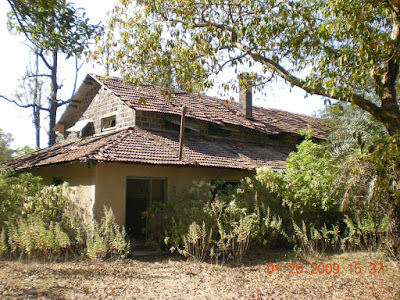
Take for example this building. It has heaths, fireplaces and exquisite curves in walls. Now no one lives in the building. It seems it has been preserved for a future project of ghost town. And why British, even post-independence era structure are left to live in the company of wild bushes and trees. Just in front of this building, there is stage made from cement concrete. It took us about ten minutes for us to spot the foundation stone of the stage which declares that it was inaugurated in 1970. Within 40 years, it has been transferred in not more than a tomb. It was supposedly named Yashwant Rangmanch.

After wandering for over two hours, we called it a day. There was nothing more to see. But we amused ourselves with a group of fort lovers who were busy reciting powadas, a kind of ballads in honor of historic warrior.  When asked for water bottle, the lone vendor at the fort said it would cost us Rs 25. We preferred not to take it and instead drank cold drinks once were in Narayanpur. That did not prevent us from tasting the bhel at fort itself.  We would never had relished such a common fare had we been not tired of walking in the sun. All in all, we did nothing great, did see nothing great but for us, it was a great experience.

When we were returning, both of us were dissatisfied that there was no relic here which we would have remembered for life. Still, we promised each other to return in the monsoon season when Sahyadri is adorned with greenery. Hope, better luck then!


Technorati Tags    
,,,,,

Sunday, January 18, 2009

Nanded, my city

I come from a city situated in the interiors of Maharashtra. Nanded, which is on the borders of Maharashtra and Karnataka, was a small town when I left it in 1997. For the last 10 years, I am living in Pune and my practical contact with the city remained took place only casually. On a recent visit to the city, I saw many changes taking place there. I just tried to chronicle some of them here. I take proud in the fact that Nanded was a cosmopolitan city and many linguistic as well as religious communities have lived here for centuries.


View Larger Map

से Nanded
The Goadavari river flows through the Nanded city. Three of the most prominent Gurudwaras are located on the banks of the river and most importantly, the river divides the city by two. The banks of the river, especially the one where Gurudwaras stand have been beautified on account of Guru-Ta-Gaddi ceremony which took place in October 2008. Even though the water of the river is mixed with many a chemicals and waste water coming from a population of about five lakhs (0.5 million), the water is relatively clean. I could spot many a common birds in the riverbed. 
से Nanded

This is the famous clock tower standing in Old Mondha area of Nanded. It is supposed to be 100 years old and has been transformed many times during this time. The tower has statues of Sardar Vallabhbhai Patel on one side and Ravindranath Tagore on another. Once upon a time, it was famous for its height. But now many a new buildings appear taller than this structure.
से Nanded

The Nagina Ghat Gurudwara standing on the bank of Godavari. This was the place where, according to folklore, Guru Gobind Singhji showed an arrogant trader how valueless his offering, that of a diamond was. The gurudwara alongwith others two glows in the evening like a jewel in dark. The beauty of its reflection in Godavari's water is simply unmatchable.
से Nanded

Nanded railway station. The station is more than 100 years old. But the face of the building has changed so many times. The present building is comparatively big. The building is cleaner than many stations in the Marathwada region, wherein Nanded falls. The relaxing appearance of the building has now become a thing of past and now professionalism is sighted everywhere. 

Saturday, June 07, 2008

Weeding Out Bodies From Mula River

The workers dredging out the weed from Mula river at Bopodi vomitted in the afternoon before having their lunch. The reason? They just had scraps of human flesh flashed across their body. The workers are developing nausea on account of this strange encounters.

The work of moving (not removing) the hyacinth from the riverbed started on Thursday after the intervention of guardian minister of Pune, Ajit Pawar. Hours after the start, the workers belonging to Siddheswar Industries Pvt. Ltd. began experiencing human bodies to the boats they were riding in. Some of the bodies were being cut by the moving cutter fitted with the boats.

"We caught at least five bodies there yesterday. Even today a couple of bodies cut by our machines. Some of the bodies were bound in the sacks," said Vinod G. Khopade, in charge of the operations at the site. The workers were more puzzled by the attitude of police who despite being told about the incidence preferred to look away.
"It is very revolting. We even caught a body of a child. The bodies lie underneath the Hyacinth bed which is spread on the river. Therefore these bodies do not come on the surface and as nobody enters the river because of hyacinth, nobody notices them," said one of the workers.

As the workers move along the river to cut the Hyacinth, bits of human flesh fly in all directions and some of the scraps even get struck in the machine itself. Majority og the bodies are that of babies and kids. Aba Takawane, the contractor of the weed romoving work, said, "My workers are suffering for two days this situation. We had complained about this situation to police but they have not taken any cognizance. Officials tell us that once the body come to the bank, they will look into the matter."

When contacted about this incidence, police personnels at Bopodi police chowky refused that any such incidence has taken place at all. According to policemen, if such a thing would have taken place, everybody in the city would have known it.

(Published in Pune Mirror on 10 May)
-------------
The hazard posed by the Hyacinth seems here to stay. Researchers, activists and authorities are vouching that only way to remove the weed is to dredge it from the river. But the controversy over the manner in which it is dumped and the way it authorities are locking horn is already started. In the tussle, city is feeling the most intense problem in the last decade.

The ongoing work of removing Hyacinth from the Mula river was stopped on Saturday citing Maharashtra Pollution Control Board’s notice. But the authorities from PCMC claimed that the work was stopped because of an assurance from Pune Municipal Corporation to complete the work. PMC on the other hand also said that it has finished cleaning its portion of the river.

Dr. Sadashiv Patole, in charge of the Hyacinth removal drive of PMC, said, "We have cleaned our part of the river. Now the ball is in the PCMC’s court. Their work has been stopped and a stretch of five kilometres is choked with Hyacinth. So the situation is still grim."

Dr. R. B. Chavan, Patole’s counterpart in PCMC claimed that the work was stopped because PMC officials promised to complete the task.

Is There Any Solution?
Dr. Vikram Ghole, head of Department of Environment Studies, University of Pune, who has done research on Hyacinth problem, says that the only way we can remove the weed from the river is mechanical one. "Various experiments to weed out the Hyacinths have been done. Even chemicals and bio-chemicals solutions have been looked at. But ultimately the only effective way is to remove it mechanically."
Noted environment expert Sridhar Mahajan also asserted the fact that it is an uphill task to extinguish Hyacinth from the river. "Only way to do it is to remove the pollution. As the pollution level increases, Hyacinth grow in abundance. That is a long term solution and seems difficult at present. Till it is done, removing the weed is only a temporary solution."

Do It and Dump It
Questions have also been asked about the way authorities dump the Hyacinth. While PCMC’s style of dumping the cut Hyacinth in the river directly attracted criticism immediately, PMC’s style also came in the line of fire. Stacks of Hyacinth can be seen on the banks of Mula which are potential breeding ground of insects, worms and mosquitos.
According to Dr. Ghole, College of Military Engineering had started a vermiculture project in its campus wherein Hyacinth were fed to the worms. That was a good and ideal experiment. But PMC and PCMC have other ways to follow. The Hyacinths are either cut and left in the river water so that it can settle in the water once it is rotten, or stacked at the banks. Both of these ways are as hazardous as Hyacinth itself, if not more.

One problem also is almost non-existent use of Hyacinth. "It has a very high content of water i. e. 90 percent. Therefore practically it is impossible to put it to use. We did some experiments and made handmade paper, bio gas etc. from Hyacinth. But the output from those experiments was too low. Therefore it could not to be implemented in practice," said Dr. Ghole.


Who’s Area Is It
If Puneites are faced with the continuance of this problem, it has something also to do with the jurisdiction problem. The Mula river, particularly the Hyacinth infected part, flow from three different administrative regions viz. PMC, PCMC and CME.

While PMC claims that it has removed all the Hyacinth in its area, it blames PCMC of not doing enough. PCMC on its part has appointed people for the task and officials claim every now and then about rooting out the problem. CME has devised an unique way to solve the problem. It has often resorted to putting beams in the reverbed in its limits so that the Hyacinth do not flow there. Its drastic result is realised when PCMC suddenly releases large quantity of water from Pavana river. The Hyacinth there comes flowing with the water with the result that almost all the river gets covered by a green carpet.

This show has been repeated even now with the ongoing drama. The developments this time do not show any sign either of any solution.

(Published in Pune Mirror on 11 May)

The Green Killer

The sight of so much greenery might satisfy an environment loving citizen. But this greenery is taking its toll on the environment itself. For the last few years, residents in Bopodi and neighbouring are complaining of health problems, which are caused by the existence of hyacinth in Mula river. But the issue has now become a plaything between two municipal corporations and College of Military Engineering also.

Officials from Pune Municipal Corporations claim they have routed out the hyacinth problem from Mutha river in PMC limits. But parts of Mula river flowing through PMC area is infected with huge spread of hyacinths. According to these officials, Pimpri-Chinchwad Municipal Corporation is pushing these hyacinths in PMC area.

"We have proof that PCMC is pushing hyacinths in Mula river, which originally comes from Pavana river. They show readiness for co-operation when approached, but suddenly they resort to same old tactic of releasing water with hyacinths without informing," said Dr. Pramod Daigude, head of the PMC health department.

Such irritated PMC is on this matter, that it has started to put girders in the riverbed so that this weed should not enter its area. It has issued expression of interest notices for inviting tenders so that the task can be given to private agencies. The process is expected to be completed within one month.

This practise was till now followed only by College of Military Engineering, which is situated on Mula river.
PCMC on its part has sent a letter to PMC denying any responsibility on the matter. Officials from PCMC, apparently taking pride in being the richest municipal corporation in Asia, shown readiness to pay the money for removal of weed. But they themselves have not done anything in the matter. When contacted, PMC officials were either unavailable or unwilling to comment.
-------------
More Problems to follow
Even when its cup of woe filled to the top, PMC is facing one more uphill task now. According to A. V. Patole, deputy head of the department and in-charge of weed removal programme, said, "Till now we used to remove weed from riverbed successfully. But now a new type of weed is coming up which is called, Pistia or Nile Cabbage. It has come basically from US and it is a major headache there. It is spread over thousands of Kms. on rivers and lakes. Only aerial spraying of pesticides is done in US but we can’t do it for environmental reasons."

Another matter of concern for PMC is a proposed construction of gas pipeline near Harris Bridge. Maharashtra Gas Ltd. has built a bund under the bridge for this pipeline. It is also causing a stoppage to the flowing hyacinths. Patole said, "Although the company has promised that it will remove the concrete bund once their construction is completed, our past experience does not allow us to believe them. So our problems are getting only complicated."
-------------
(Published in Pune Mirror on 8 April)

Sunday, April 08, 2007

Shivaji: How many hurdles?

There is a song in the movie Padayappa. That song literally means : There are a thousand hurdles in life, but for you, these hurdles are only a step. That fits well in the real life of the movie's hero Rajinikant as well.
At the one hand his 'Shivaji the boss' is creating much expexctations from all quarters. At the other hand, the perk and rumenaration that Rajni got has created a lot of buzzword. In Indian moviedom, there is hardly any actor at this moment to match his popularity and stature. Be as it may, rajinikant still faces some hurdles and as is shown in his many a films, he conquers them all. This time he has an uphill task ahead in his real life and every eye is on him now.Shivaji is directed by Shankar who gave us many hits like Kadhalan, Gentleman, Mudhalvan, Jeans and Indian. He is a stylish director but any director working with Rajini must bear one of the most daunting task and that task is to fulfill the public's expectations. And this task is compounded this time from the very first day of announcement of the 'Shivaji-the boss.' The difficulties faced by Rajinikant that I mentioned above starts from this severity. Rajini is not only the flagh bearer of Tamil film industry, he is an icon for millions of his rasigans. He might have enjoyed their fierce loyalty and unconditional love for over two decades, he also has to respond to their anticipations. That he does so time and again must be credited to his uncanny down-to-earthness.If he by chance misses the bus, a debacle is sure to follow as was proved at the time of Baba.To add to the woes of the Superstar, some external elements chip in, which make the outcome of a Rajni movie more thrilling than the movie itself. This time also, as the talk was on of Shivaji being a launch vehicle for the Rajini to his political career, there were many who contributed to the saga of Shivaji. First one was the Tamilnadu government itself which, fearing an onrush of the crowd and thereby encashment of the popularity by distributors, assumed all rights for the control of theatre ticket rates in Tamilnadu. As if it was not enough, VIjay T. Rajinder, an influencing personality in the Kollywood, cautioned against the hike of the ticket rates and declared that he will not sit quietly if the rates are increased.Then surfaced Rajinis' old nemesis, Pattali Makkal Katchi which raised its head again to oppose the Shivaji. It particularly targeted a song 'oru koodai sunlight, oru koodai moonlight,' on the pretext of using English words and sentences in the song. The party workers (or leaders?) even have shown readiness for an agitation for this cause. Pattali Makkal Katchi people have a history of opposing to Rajini, first time showing their trait at the time of release of Baba. But this time, Shivaji has faced resistance from one more quarter, and that is an unexpected one. A certain trade union in Thanjavoor has opposed some references to the Kaveri river in a song in Shivaji and they too seem ready for an agitation. What is funny in all this episode is the statement given by this union, in which it is said that Rajini has kept mum many times on Kaveri water dispute. That's why, according to this union, he has no right to use Kaveri's name in any song in his movie.As Shivaji-the boss has rewritten some records in the movie history of India, it has also has to face an unprecedented hurdle now. The Kannada Rakshan Vedike, an organisation specialing in isolating the Kannada peolple from neighbouring states, has decided to oppose the release of Shivaji-the boss in Karnataka. It is unusual development. Usually, even when non Kannada movies were banned or withheld from Karnataka (pls see some of my previous posts), Rajini films have been given the go. But this time now, the case is different. WIth the Kaveri tribunal award going in favour of Tamilnadu, Kannada Rakshan Vedike is full swing and to show its opposition to Tamilnadu, it has decided to play with Shivaji's prospects.