Thursday, September 24, 2015

CM Fadnavis Shows His Distinctness

1.9 Devendra Fadnavis, the Chief Minister of Maharashtra, has showed his distinctness with his measured yet aggressive response to an open letter written by journalist Rajdeep Sardesai. This was not a unique action as many politicians of yore had taken to writing articles in the newspapers to articulate their position. Former Prime Minister Atal Bihari Vajpayee even penned long muse when he was mired in political controversies and problems. However, what makes Fadnavis stand out is that he has taken to the medium often used against him for last one year and while defending his own position, he has put forward the work he was doing. This would serve not only in taming the hostility of the media towards him, in particular, and his government, in general, but also soothing his political ally Shiv Sena which is in the government bashing mode ever since it decided to share power.

Sardesai, often seen as an adversary of the Hinduist ideology which Fadnavis adheres to, had targeted Fadnavis of failing on many counts and letting down those who had hopes in him. "I was one of those who expected a lot from this leader who come to power with his youth and vision," Sardesai wrote. He had taken up mainly three points which underlined, in his eyes, the hopelessness of the present government. These points were - ban in certain municipal corporation limits on sale of the meat to be enforced for eight days during the Paryushan Parva of Jain community; transfer of Rakesh Maria, the Commissioner of Police, Mumbai during the course of investigation in high-profile Sheena Bora murder case, ostensibly to curtail the probe and third was a recent circular issued by the government which allegedly allowed the police to frame sedition charges against anyone who would criticize the public representatives. The letter was published in English, Hindi and Marathi publications as well and received due attention.

This ruffled quite few feathers in Bharatiya Janata Party and it was felt that this attack must be countered. But no one expected that CM himself would lead from the front and give a befitting reply to a journo with a stature such as Sardesai has.

That the CM replying to an open letter was itself a novelty. But Fadnavis added another dimension to it by twisting the reply and coloring it in an Urban-Agrarian conflict. His terse sentence that 'I am more concerned with providing food to the drought-hit farmers than filling your plate with non-veg' is a classic example of how a politician, even when well wishing and sincere, can turn any debate in his or her own stride. The BJP has outfoxed Congress with great cunningness in recent times because of this type of willy politicians. In fact, Congress is now almost bereft of clever leader who could mould the discourse any way they like.

The Twitter was abuzz with the development and the hashtag #DevendraSlapsRajdeep remained among top trends for two days. Various groups on WhatsApp were replete with the text of the letter. It took 24 hours for Sardesai to reply to CM's letter but in his immediate reaction, he just tweeted -

Whatever the outcome of the debate, one thing is sure - that this BJP government is a different pot to handle for the critics and it is going to break more norms in the future.

Sunday, September 06, 2015

People are enjoying religion as never before

WP_20150904_025 Twice within last ten days, I travelled to Nashik, that old city in North Maharashtra which, it is said, Lord Ram, Seeta and Lakshman visited while in their exile to forest. The city reverberates with the same ancient spirit of holiness and faith. And this time, the spirit is especially evident as millions of devotees throng to the banks of river Godavari to have a dip in its specially-made clean stream during the auspicious period of Sinhastha.

Kumbh Mela, the grandest of all festivals is currently on in the city. Kumbh is the 12-yearly gathering of almost all important saints and holy men in Hindu faith. But my trips to Nashik were not connected in any way to it and I was not there at the shahi snaan, the extravagant holy bath done by sadhus and devotees. However, once after putting my feet on this land of pious worshippers, I couldn't keep myself off from the enchanting glimpses offered at the ghats.

The main ghat of the Panchvati area glittered with all kinds of lightings. Men, women and children, in all kinds of attires and with varying ages, filled themselves and their kin with happiness of having attained one of the most relieving satisfaction ordained by the culture. Innumerable ascetics, with almost everyone in his unique dressing and hairstyle, walked past the frenzied crowds with ease, with barely any concern or disdain for the scene around them. They were just a fraction of the sadhus camping around this city and tens, if not hundred, times more than them station in specially created colony.

WP_20150904_010 The pantheon of godmen keeps enlarging, not only in Hindu but probably every religion of the world. It may not particularly point towards the increasing piety of the faith but it doesn't show any diminishing of its hold either. True, people are not bound by the religious dogmas the way they used to be, say, a hundred years ago. But they are not letting it go out of their conscience either.

Speaking more accurately, the people are enjoying the religion as they never did in the past. This holds true especially in case of Hindu faith where all leashes are open in an already disorganized fold and everyone is free to follow his own path.

For centuries, Hindus were infected with caste system with its strict hierarchical demarcations and very few individuals, if any, took joy in adhering to his or her rituals. This was true for the castes at lower rung of social ladder and even more for the so called upper castes. The members of some of the outcast castes were not even allowed to walk side by side with those ruling them.

After independence in 1947 and introduction of the Constitution of India, these socially deprived people attained the freedom and equality, howsoever compromised they might be at times. However, the members of these communities were still languishing in economic deprivation as centuries of slavery and exploitation left them in penury. They struggled for existence while ruling castes jostled with each other to capture modern means of progress.

Add to this that elusive emancipation of women which was on debating table for two centuries. That is realized, again, in a limited manner. But whatever is realized is enough to bring about a new uprising in the hitherto repressed expressions of emotions.  Female were no longer weaker sex. All shackles binding them were free.

All this changed in 1991-92 when India, having forced by the abject restrictions, mended its path - from Nahruvian economy of deprivation to liberal economy of post-Cold War era. Coupled with reservation in jobs and education, the backward classes came closer to their former masters while forward castes, due to their advantageous position, accumulated fortunes in greater proportion where once even shadows of their forefathers was forbidden.

WP_20150904_027These developments manifested in the form of frolicking women in Ram Ghat at Panchwati in Nashik where Lakshman said to have marked a line for Seeta warning her not to cross it. They came to fore in the form of groups of villagers, clearly showing their rural origins and caste markings, freely offering aartis to the river Godavari.

These all are signs that gone are the days when religion used to be a force to be feared of, an all pervasive power which curtailed individual’s freedom. Now, individual is bending his faith at his comfort and relishing the offerings as just another recipe to be savored.

In Nashik, the traders and businessmen complained that their business was hit by low numbers of devotees who did not turn up on the auspicious day because of heavy deployment of security personnel. The merit of this complaint is another thing. But the very fact that these businessmen looked at this event as an opportunity to make money because of large number of devotees itself proved that this was not just a spiritual and sacred occasion, but a chance of wealth creation and this because devotees were prepared to shed their money for earthly pleasures.

The self-professed progressives pride themselves in deriding the religion and rituals. They don’t feel any need to separate grain and chaff. Last month, in a program organized by weekly Sadhana, veteran journalist warned the intellectuals of the pitfall. “You are right in denouncing religious dogmas and taboos. But I tell you, please look at the religion seriously,” he said. If the ongoing Kumbh has any message to give, it is this.

Wednesday, June 10, 2015

Why Raj Thackeray still rules the audience

Raj_thumb%25255B2%25255D[1] After tasting two consecutive defeats in the parliamentary and assembly elections in Maharashtra, the political pundits and public in general, thought that Raj Thackeray led Maharashtra Navnirman Sena (MNS) was doomed and his political career is finished. With no presence in either house of parliament and but nominal presence in state legislature - MNS has just one member in state assembly - Raj's clout was nowhere to be seen. Even the numerous corporators elected on his party tickets failed to put up any show of performance earning a scorn from public as much as from Raj himself. Thus the railway engine - the election symbol of MNS- was on the downward path. The famed and feared oratory of perpetually angry Raj was but a shadow of its theatrical version seen mere five years ago.

However, even today, when Thackeray's bĂȘte noir Shiv Sena is accommodated itself in the roles of partner in power as also the player in politics and state's politics fragmented beyond repair, Raj rules the public mind.

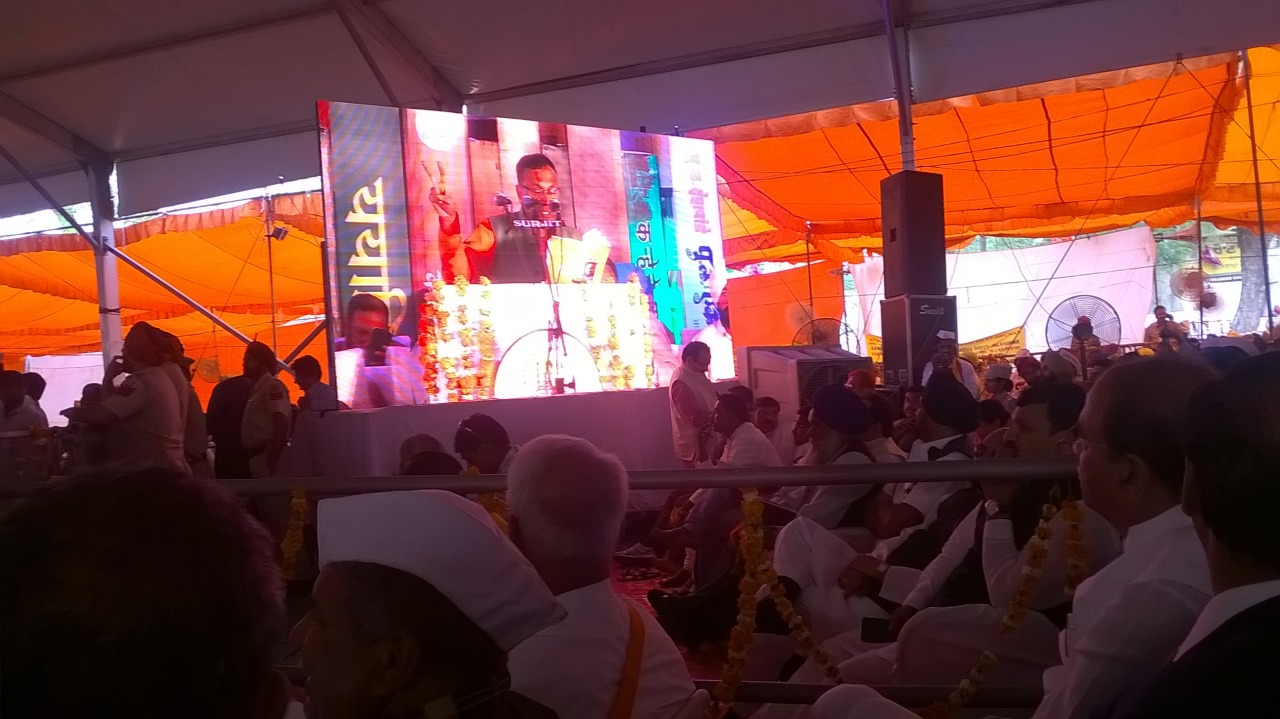
The fact came to fore on Tuesday, June 10, when Raj attended a function to confer Sant Namdev National Award to Prakash Singh Badal, Chief Minister of Punjab. The award was given by Devendra Fadnavis, Chief Minister of Maharashtra and the award was given by Sarhad, an NGO based in Pune. Raj was the Chief Guest at the function. When his name was announced, there was a loud cheer from the audience - a mixed bag of Maharashtrians and Sikh citizens.

He started his speech by addressing 'all Marathi people' and in the same breath added that he deemed Sikhs as Marathi people. There was a loud clapping which was hardly surprising.

Then true to his fame for wit and punches, he quipped that Badal (cloud) had come in Maharashtra on the eve of monsoon so that there may be rain. Every one in the auditorium applauded the nice words of play and novel way of welcome. Even Badal seemed to be curious ad he was seen asking Fadnavis a translation of the humor.

Taking a cue from Sarhad's Sanjay Nahar, Raj then went on to say that Sant Namdev bound Maharashtra and Punjab's cultures in one thread and only a tailor could do this. This was an hitherto unnoticed and unused observation which pointed to the Sant Namdev's caste (Shimpi). Had the public not responded with applause and appreciation, they would be blamed. But the praise was well received and hall resonated with cheers. Even the Sikhs who knew Marathi put their seal of appreciation on the quirky description of the great work this 13th century saint did. Clearly he stole the show. Even Fadnavis borrowed his words to express his feelings.

Raj, like his cousin Uddhav and uncle Bal Thackeray, is adept at capturing the mood of the masses and regaling them to his advantage. He may have lost elections but he has not lost his charms and talent. That is the promise for the time for his partymen.

Tuesday, June 09, 2015

Chimanrao for this generation

image

It has been over a century since C. V. Joshi created the most famous literary character of Maharashtra – Chimanrao. This quintessential middle-class clerk is to the Maharashtra what Feluda is to the Bengal and Swamy is to the Karnataka – though their genres are a distant apart. Chimanrao, a common man serving under the British masters and running the household as thousands of his generation did, is always the butt of the jokes and precarious situations because of his innocence and misplaced priorities. However, it brings out the deficiencies and righteousness imbibed in every educated and civil citizen which remain unmanifest because of want of situation.

In the era of Facebook and WhatsAap, where the innocence gives way to the utilitarianism and pragmatism, the humorous idealism and dreamy naiveté have become a thing of the past. It seemed buried under a layer of forgetfulness.

Sandook, the movie released on June 5, has scratched this layer if not unearthed it and brought back those lovable features and guiltless nastiness on the scene. As I write this, the movie is about to complete its first week and going by the response it is receiving, it seems to make a good stay at the multiplexes.

Sandook is the story of Wamanrao Ashtaputre, a gullible and chronic daydreamer, living with his wife and about-to-become teen son. The movie relies on a plot rooted in the British era, the 1940s, and exploits the ironies, idiosyncrasy and discomfiture of the protagonist to the hilt. It is amply supplemented with the dose of mystery but that part of the film has not come out as strongly as the comical situation have.

Wamanrao's is a lineage of the illustrious men who have registered valor and bravery during the respective periods of Wamanrao's ancestors. As is the way of the Maharashtrians, Wamanrao is too fond of the history and is deeply into eulogizing the glory of his ancestors even to the point of worship. How he nurtures an ambition to join the league of brave hearts, occupied in no small measure by his ancestors, forms the plot of the movie.

Sumit Raghvan is one of the shining stars of the galaxy of non-Maharashtrians who have enriched the Marathi movie and drama world. This is his first Marathi movie but with his acting prowess, he has adeptly illumined this crisply-written and well-executed movie. He is superbly supported by a big star cast including Sharad Ponkshe, Bhargavi Chirmule and Arun Nalawade. The language, the manners and the ambiance takes you to the typical Maharashtrian home of past. The chemistry between Raghvan and Chirmule is amazing.

Their skirmishes of the husband-wife duo as also Wamanrao's frequent misadventures are the stuff what one calls the clean comedy. It is bereft of any slapstick mannerisms or dual-meaning words. The scenes and dialogues are canned in a manner befitting the life a non-descript person who makes fool of himself in an attempt to write a glaring chapter in the history. True to the spirit of the script, Raghvan brings out the suppressed desire of doing something manly and at the goose-like nature of the protagonist. His expressions and dialogue delivery speak volumes about his experience as a stage artist. One wishes to see this multi-talented artist more on Marathi screen in the future also.

Thankfully, the movie has only two songs and they have come out well.

The entire characterization of Wamanrao, portrayed by Raghvan, is in the line of Charlie Chaplin. It is also reminiscent of the Chimanrao and especially his verbal duals with Shyamrao (Sharad Ponkshe) remind of the duals between Chimanrao and Gundyabhau.

There are some discrepancies but they do not obstruct the enjoyment. For example, any married man in 1940s did not have just one son in the family as also the over-friendliness in the father-son duo are also not from that period.

All in all, Sandook is a must watch movie for all Marathi movie aficionados.

Sunday, April 05, 2015

Marathi and Punjabi Warmth Gets New Manifestation

          Deputy Chief Minister of Punjab Sukhbir Singh Badal (right) presenting a sword to the Chief Minister of Maharashtra Devendra Fadnavis as Union Minister for Railways Suresh Prabhu (center) looks on.
The warmth of relations between Marathi and Punjabi received a new manifestation on Sunday as leaders from the two states thanked each other and announced a slew of measures for promoting each other’s culture in both states.
As the 88th All India Marathi Literary Meet concluded in Ghuman in Punjab, Union Railway Minister Suresh Prabhu, Chief Minister of Maharashtra Devendra Fadnavis, Deputy Chief Minister of Punjab Sukhbir Singh Badal and other leaders showered praise on both the cultures. Maharashtra’s Cultural Affairs Minister Vinod Tawade, Dnyanpeeth Awardee Kashmiri author Rehman Rahi, communist leader Jatinder Pannu were present on the occasion.
This is the first time that the Marathi meet was held in Punjab which the latter had declared as its official event. It provided all the infrastructure and hospitality facilities for the three day meet which was appreciated by all. Around 7000 people from Maharashtra camped in the small town of Ghuman, about 40 kms from Amritsar. The town is known for the memorial of Shiromani Bhagat Namdev, originally Sant Namdev from Maharashtra. Pune-based NGO Sarhad and Akhil Bharatiya Marathi Sahitya Mahamandal were the organizers of the meet.
Speaking on the occasion, Prabhu said, “While Marathi literary meet has truly crossed threshold this year, Punjab is the food bowl of India. Punjab and Maharashtra's relations are extraordinary. We can never think where martyrs Bhagat Singh, Sukhdev & Rajguru came from. Marathi people love bhagat Singh more than Rajguru. Marathi literary meet may help generate such gems for India. I am sure that literature can literary persons can bring people together.”
In his address, Badal said that it is Punjab’s tradition to respect all the religion on the world equally. He proposed that such an event should be held every year so that this exchange would go further. He reminded that Chief Minister Prakash Singh Badal had promised to set up a Chair in the Guru Nanak Devji University in Amritsar in the name of Baba Namdev. Badal also demanded that Ghuman should be brought on the railway map so that devotees from both the states can travel directly to the respective states.
Appreciating and reciprocating this gesture, Fadnavis said, “The literature lays the foundation for bridging linguistic and cultural barriers. I fully endorse Badal’s proposal and we will try to organize Punjabi festival in Maharashtra every year. Also, I announce that we will set up Shri Guru Gobind Singhji Chair in Swami Ramanand Teerth Marathwada University at Nanded. Digitization can do everything but it can't create sensibilities. Only literature can create sensibilities. Literature has infuse confidence in common man to fight adeversities and that larger community is behind him.”
All the leaders and dignitaries present in the ceremony, including Gen. (Retd.) J. J. Singh, Sikkim’s Governor Srinivas Patil, Pannu and Tawade thanked the Punjabi people and government for the excellent hospitality given by them.
Earlier in the day, the Union Minister of State for Environment and Climate Change Prakash Javadekar said that the Prime Minister Narendra Modi too have extended his warm greetings for this literary fest. Expressing gratitude of Punjab government in conducting this event, he said that he was thankful to the Chief Minister Punjab Prakash Singh Badal and the Punjab government on behalf of entire Maratha community for their hospitality.

Maharashtrians Enjoy the Punjabi Hospitality

The 88th edition of the Akhil Bhartiya Marathi Sahitya Sammelan (ABMSS) has given the Maharashtrians the occasion to enjoy the hospitality of the Punjabi people. The entire Ghuman village in Gurdaspur district has turned into Mini Maharashtra for the last threee days.

The literary meet,surprisingly, has become centre of attraction for many. The guests from Maharashtra are not only enjoying the Marathi programmes, but are also relishing the Punjabi programmes and most of all, the food. Every village in the town, apart from the Gurudwaras dotting the horizons, are filled with langars offering free food, tea, refreshments and even sugarcane juice.

Those visiting Punjab for the first time are having gala time and really enjoying the attention they are getting. Today, Vinod Tawade, Minister of Education and Culture of Maharashtra, visited the media center and said that even Maharashtra would not offer such hospitality as extended by the Punjab government. Many people I spoke to said that they would relish the moments spent in Punjab for the rest of their life.

Friday, March 13, 2015

The Solidarity of Tainted

cartoon 12 March-c