Saturday, January 31, 2009

Trip to Purandar

The Departure

से My Photographs
Even before the day begun on January 26th,  we had decided to go to Purandar fort this time. There was a lot of deliberation over the matter between us friends for over two months. But it would have been foolish to let go this opportunity given by Republic Day to refresh ourselves. Our first choice was Rajgad, but as one by one members of our team walked out, only me and Tanaji found ourselves on the road. It was about eight o’clock in the morning when Tanaji drove away from Swargate, me riding behind him. He took me all the way to the fort and bought back safe and sound. When we were back, I felt each part of my body was rebelling like the people in socialist parties do. I could just wonder what the condition of Tanaji was.

The Road to Hell

से Purandar
While  embarking on the trip, we had no fair idea as to what is the condition of the road to this historic fort is. I had read many times kind of travelogues trekkers and tourists have written about the fort. In July last year, I almost made it to the fort but came away midway sincew I thought I would not get enough time. I was correct in that respect as the fort stretches to a bvast land and it has a hright of almost 22,000 ft above sea level.

However, it is the road to the fort that tests one’s patience and endurance. It seems as if the road was made in tar first at the time of Shivaji and since then there has been no repairs. The pebbleshave all beenspread on the road as if one spreads butter on a slice of bread. The vehicle have to be extra conscious for being skid or developing punctures. It also consumes a lot of energy also. If the second most important fort in Shivaji’s kingdom can be neglected like this, how far can one expect about other historical places. The slope leading to Purandar fort is one of the messiest roads in the world, to say the least. If anybody asks me an advice, I would rather say that take your vehicle to the base of the fort and thereon keep climbing by foot. It will consume your time and energy, but it won’t bring you a sense of helplessness, loneliness and frustration which the vehicle road will bring. And if it is dangerous and tiresome while climbing, it is 100 times more dangerous and time consuming while coming down.


The First View

से Purandar
The path to fort might be beset with difficulties, but once you set your foot at the entrance of the fort, it is only history and valor that surrounds you. At the entrance of the fort, a statue of Murar Baji Deshpande has been erected in honour to this great fighter. Murar Baji was the custodian of the fort when Moghul commander Dilerkhan attacked the fort in 1665 Dilerkhan bombarded Purandar with artillery but could not win over the fort. With his handful of men, Murar Baji was fighting the enemy. It is said that Khan had offered him to come to Mughals and be rewarded but he chose otherwise. This brave warrior gave up his life in defending the fort for his beloved king, Chhatrapati Shivaji. The statue sufficiently shows the bravery and valor of the fighter. It also reminds one that Maratha empire was created from the contribution of such selfless people.

The statue is at a relatively flat area and there is a lake nearby. In historic times, this might have been used by the people living on the fort for drinking water but is not used now. As one passes by the statue, the grand remnants of the fort can be seen in the background.


The Grand Neglect

If you think you can skip Purandar for want of excitig attractions, you may be forgiven. It does not have the proximity or ease like Sinhgad and it does not have charm or monuments like Shivneri or Pratapgad. Whatever remnants one sees on Purandar are standing in utter neglect. To make it worse, no information about these mute witnesses to history is available on the fort. There are buildings on the fort suggesting that British officers enjoyed a good stay here prior to 1857 but that is also not explicitly displayed. We can draw only inferences or make guesses based on the structures. There are two identical buildings here which might have been churches as the place for bell can be clearly seen. The walls of these churches have been littered with names of those who unfortunately happened to have visited the sites. Unable to produce such grand examples themselves, they have instead chose to put their names on the existing building.

से Purandar
There are also barracks on the fort supposed to be used by the soldiers of East India Company. All these are abandoned now except for those which are given to National Cadet Corps. NCC controls some part of the fort even now.

After returning to Pune, when we searched the history of the fort, it was found that the German war criminals were placed on the fort after the two world wars. The construction of the buildings and manner in which they are standing reinforces the fact. The authorities, that of Archaeological Survey of India (which controls the fort) and revenue department of Maharashtra (under which the territory comes) either think that every tourist is well informed about this history or they just do not want everybody to know the same. Otherwise they would have placed some boards, guides or something to that effect. The forgotten grandeur of this historic witness is matched with the equally grand neglect by present authorities.


The Vast Expanse

से Purandar
Looked from the Narayanpur, from where only you can go to fort, Purandar seems very small. Its magnificence is not so imposing as the Sinhgad. But once you are at the top, one realizes what an expanse this fort has. Along with its twin fort, Vajragad, the fort has a vast expanse. Though most of the places which might have served for the cause of Shivaji’s Sawrajay have now become extinct. We could not find many places where we could identify the exact places of incidences, except for Sambhaji’s birthplace. Chhatrpati Sambhaji, son of Shivaji was born on this fort on 16 May 1657.  After about a two centuries, Sawai Madhavrao Peshwa was born on this fort. After the fall of Maratha empire, the fort came to East India Company.

The Modern History
से Purandar
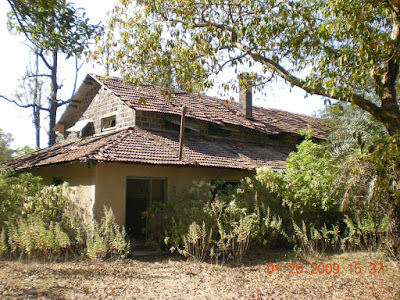
It is not that Purandar is condemned to perpetually lost in the nostalgia of an empire building at few point of times in history. Until now, it was home to the human footprints and ventures. We could spot two buildings which served as bakery during 18 and 19th century.  The building is one of the classic examples of British era buildings and has many features which are hardly seen now.

Take for example this building. It has heaths, fireplaces and exquisite curves in walls. Now no one lives in the building. It seems it has been preserved for a future project of ghost town. And why British, even post-independence era structure are left to live in the company of wild bushes and trees. Just in front of this building, there is stage made from cement concrete. It took us about ten minutes for us to spot the foundation stone of the stage which declares that it was inaugurated in 1970. Within 40 years, it has been transferred in not more than a tomb. It was supposedly named Yashwant Rangmanch.

After wandering for over two hours, we called it a day. There was nothing more to see. But we amused ourselves with a group of fort lovers who were busy reciting powadas, a kind of ballads in honor of historic warrior.  When asked for water bottle, the lone vendor at the fort said it would cost us Rs 25. We preferred not to take it and instead drank cold drinks once were in Narayanpur. That did not prevent us from tasting the bhel at fort itself.  We would never had relished such a common fare had we been not tired of walking in the sun. All in all, we did nothing great, did see nothing great but for us, it was a great experience.

When we were returning, both of us were dissatisfied that there was no relic here which we would have remembered for life. Still, we promised each other to return in the monsoon season when Sahyadri is adorned with greenery. Hope, better luck then!


Technorati Tags    
,,,,,

Wednesday, January 28, 2009

It does not happen only in India

Just when I casually passing through the Le Monde, I came across this news.
Six persons have been arrested for a fraud worth 450 million euros. According to the paper, British law enforcement agencies were investigating the matter since 2005. The identities of the persons have not been disclosed. I hope there are no Indians in it.
The though that came to me was : there are other places on earth where frauds and scams are taking place and coming to light with each passing day. India is not the only place. I have yet to figure out wherther I should take pride in the fact or not.

Tuesday, January 27, 2009

Purandar

Republic Day At Purandar


About three years ago, I spent my Republic Day holiday wandering in Pune with my friends. That was the day when I saw Shaniwar Wada first time. This time around I was at Purandar. Yesterday we went to here with my friend Tanaji. The famous fort in the history of Maratha empire. This was the fort where Chhatrapti Sambhaji born. Many a sites on the fort are in ruins. I am going to write about it later. But what made our trip special was that it was a Republic Day and we were on a fort once owned and occupied by Chhatrapati Shivaji.


The flag hoisting on the fort was done by Circle Officer of Purandar Taluka. Not many people were present at the occasion. But as the day progressed, people came in large numbers. The chanting of 'Shivaji Maharaj Ki Jai' could be heard everywhere. We left early, at about 3 Pm so we do not no how many people were there in the evening.

 -------------


Technorati Tags     ,,,,,,

Friday, January 23, 2009

The Tiger Turns 83

Even though the name Bal Thackeraydoes not arouse same level of fear, awe or appreciation from the general public as it commanded say a decade ago, he is still the formidable force in Maharashtra. His party is nothing compared to his own personal charm. In Shiv Sena, only Thackeray Senior’s word is final and carried some word. Owing to his declined health condition, his word does not come to the public directly now. Either it is an editorial in Saamana, the party organ or a message through his son Uddhav Thackeray that common people get to know what he wants.

It is this kind of monopoly by Uddhav and his cotery over Thackeray that led Raj Thackeray to break away from his uncle, his original mentor in politics. It is an adage in Shiv Sena that Thackeray Sr. can not do any wrong. But it is a fact that he wronged in judging the potential of his nephew. Now Raj, carrying anti-north Indians and pro-Marathi agenda through Maharashtra Navnirman Sena (MNS) has taken much ground below Shiv Sena's feet and at times SS is found to be dragging behind Raj. The agenda orginally brought in by SS in 1960s was later put on back burner in 1980s when Shiv Sena opted for an alliance with Bharatiya Janata Party (BJP). The alliance adopted an agenda of Hinduist ideology.

Bal Thackeray stands out in many Hinduist parties for his frankness and open headed approach. He is probably the only leader in India who denounces Hindu priests and traditions followed in the temples. He was also the only leader in 1992, after the Babri mosque demolition, to accept the responsibility of the incident. "If the persons (those who brought down the structure) were Shiv Sainiks, I am proud of them," he said publicly at that time. The catch was nobody was and is sure whether it was true. But Thackerey managed to impress public with his boldness and public started to look down upon BJP. More recently does not one saw him welcoming 'Hindu Terrorists? On could mark he was saying that Hindu terrorists are all welcome but they should hit the bull's eye.

In one such instances, he showed to what extent he can go. When the Shirdi's Sai Sansthan decided to install a gold throne for Sai Baba, Thackeray decried the decision. Lokmat, a prominent Marathi daily took offence and criticized Thackeray Sr. sighting his own style of sitting on a throne in his bunglow. Next day itself, Thackeray Sr. sent his own throne to the Lokmat office, saying that the throne was given by his own 'people with love and devotion' and he is satisfied with public's love alone. The incidence created an amusing scene for the media in Maharashtra. Only when the top management officers of Lokamt came and apologised could the throne be taken back to Thackerey's bunglow.

For better or for worse, Maharashtra loves Thackerey Sr. No other leader has managed to draw people's love, affection, anger, frustration, devotion and that too for more than four decades! Even those who have left him for good, like deputy chief minister Chhagan Bhujbal or ex-chief minister Narayan Rane do not shy away from praising or adoring him. It is not easy for outsiders and people with preconceived notions to understand how this man of relatively frail body and no logical reasoning manage to stir up passions in millions of people.

For an unpassioned and detached viewer like me, who has not attended a single rally addressed by him even in my home town but who has immense admiration for the power he holds, it is a sort of unhappy thing that he no more draws cartoon. Given that the cartoon-like politics of today and caricature-like personalities, perhaps he does not require to do so. Whatever old samples of his art I get to see, I enjoy it immensely.

Thursday, January 22, 2009

Autorickshaws on Different Roads

In one of my previous posts, I had mentioned about the hi-tech auto rickshaws. In a further development, the Pune city is set to see the rising numbers of autorickshaws plying on Compressed Natural Gas (CNG). India is also getting new rickshaws running on solar power but it is a far fetched thing to expect that it will be a reality soon.
In Pune, some PMPML buses already run on CNG. Now, according to RTO officials, about five to six autos have taken to the alternative fuel. Bhurelal Committee had recommended to run autos on CNG. But Regional Transport Office had not given the permission for changing over to new fuel because the city had not enough supply of CNG. Now, as the CNG outlets have grew in numbers, autorickshaws have got green signal to fit with the CNG kit. About Rs 25 to 30 Thousand are to be spent for CNG kits to be fitted in the autorickshaws.

The Council for Scientific and Industrial Research (CSIR), the premier research institute of the country, launched "Solekshaw", the solar-electric rickshaw for eco-friendly urban transport on the occasion of Gandhi Jayanti

The dual-powered Soleckshaw is the CSIR's solution for the dual problem of decent employment generation for the masses and mitigation of global warming. Currently, transport sector accounts for more than 60 percent increase in Green House Gas (GHG) emission in India. As of now, no powered vehicle or transport system is free from carbon dioxide emission. Soleckshaw, with its zero carbon foot print and the trend of widespread use, is expected to reverse global warming and protect the planet from the perils of the climate change.

CSIR vision, titled, CSIR-800 and aimed at empowering 800 million Indians, gave way to the Soleckshaw. Mark I version of Soleckshaw has been designed, developed and prototyped by the CSIR's national laboratory, the Central Mechanical Engineering Research Institute (CMERI) at Durgapur, in a record time of eight months. The accompanying solar charging station for swapping the batteries has been set up by the Central Electronics Limited (CEL), a Government undertaking. The specifically designed robust low power high torque brushless DC motor has been developed for the first time in India by Crompton Greaves based on the specifications provided by CMERI.


Technical Features

· Power source : Solar and human

· Drive : Motor - assisted pedal-driven

· Electric motor : BLDC hub motor: 240-350 W, 36 V with regenerative capabilities

· Transmission : Chain drive with differential and two ratios

· Brakes : Three-wheel braking

· Seating capacity : Two passengers

· Payload : 200 kg

· (excluding driver)

· Speed limit : 15 kmph


The Advanced Materials & Process Research Institute (AMPRI), another constituent laboratory of CSIR supported for the Technology Demonstration Project (TDP). The Centre for Rural Development (CRD), an NGO working on rickshaw banks in different cities, joined the TDP as a partner for wider deployment of Soleckshaw. Innovative business model is being evolved with NGOs, banks, environment-loving corporates and manufacturing organizations to make the rickshaw available to the drivers at the cost of an ordinary rickshaw.

The advanced versions of Soleckshaw Mark II and Mark III with better aesthetics, ergonomics, speed and recumbent driving position is expected to be ready for launch during the Commonwealth Games in 2010.

(The information on Soleckshaw provided by PIB Features)

Sunday, January 18, 2009

Nanded, my city

I come from a city situated in the interiors of Maharashtra. Nanded, which is on the borders of Maharashtra and Karnataka, was a small town when I left it in 1997. For the last 10 years, I am living in Pune and my practical contact with the city remained took place only casually. On a recent visit to the city, I saw many changes taking place there. I just tried to chronicle some of them here. I take proud in the fact that Nanded was a cosmopolitan city and many linguistic as well as religious communities have lived here for centuries.


View Larger Map

से Nanded
The Goadavari river flows through the Nanded city. Three of the most prominent Gurudwaras are located on the banks of the river and most importantly, the river divides the city by two. The banks of the river, especially the one where Gurudwaras stand have been beautified on account of Guru-Ta-Gaddi ceremony which took place in October 2008. Even though the water of the river is mixed with many a chemicals and waste water coming from a population of about five lakhs (0.5 million), the water is relatively clean. I could spot many a common birds in the riverbed. 
से Nanded

This is the famous clock tower standing in Old Mondha area of Nanded. It is supposed to be 100 years old and has been transformed many times during this time. The tower has statues of Sardar Vallabhbhai Patel on one side and Ravindranath Tagore on another. Once upon a time, it was famous for its height. But now many a new buildings appear taller than this structure.
से Nanded

The Nagina Ghat Gurudwara standing on the bank of Godavari. This was the place where, according to folklore, Guru Gobind Singhji showed an arrogant trader how valueless his offering, that of a diamond was. The gurudwara alongwith others two glows in the evening like a jewel in dark. The beauty of its reflection in Godavari's water is simply unmatchable.
से Nanded

Nanded railway station. The station is more than 100 years old. But the face of the building has changed so many times. The present building is comparatively big. The building is cleaner than many stations in the Marathwada region, wherein Nanded falls. The relaxing appearance of the building has now become a thing of past and now professionalism is sighted everywhere. 

Saturday, January 17, 2009

HAL employees to get Fifth Pay Commission

The Union Minister for Chemicals & Fertilizers Ramvilas Paswan announced on Saturday that revised pay scales according to Justice Mohan Commiittee recommendations on 5th Pay Commission would be applicable to Hindustan Antibiotics employees from 17 Jan 2009.The arrears from 1997 would be given in instalments in due course of time and the timetable for arrears distribution would be discussed with the HAL Employees Unions. Every employee will also get Rs 1000 as bonus in the new year.

Paswan was speaking at the inauguration of the new Cephalosporin plant of HAL in Pimpri today. The HAL Union General Secretary Shri Pataskar said that employees were working on the same salary since 1992 and badly needed the pay hike. Mahatma's wife Smt Kasturba Gandhi died in Pune after she could not get the required medicines after which Nehru in 1954 had announced setting up of Hindustan Antibiotics. Selling such cos and not turning them around was wrong as was done during Arun Shourie's time. 

The plant has been set up at a cost of Rs 20.17 crores  in a record 9 months time and will enable the company to manufacture the new generation antibiotic for the domestic & international market. The immediate application of new pay scales would increase the salaries of employees by roughly 25 percent and the benefits would be in the range of Rs 1500-8000 depending on the level of the employees.